
Who We Are
Our Purpose
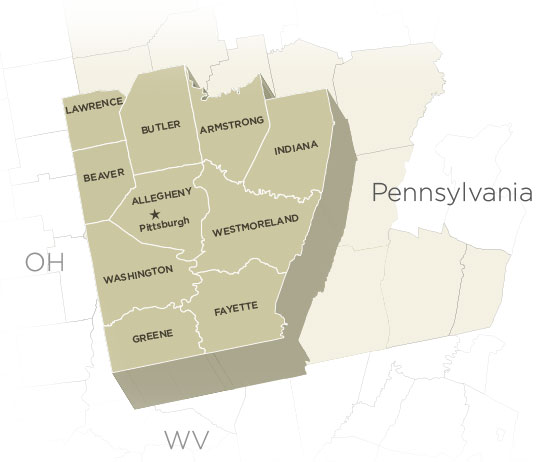
The Allegheny Conference on Community Development is one of the United States’ foremost civic leadership organizations. For more than 75 years, the Conference has been bringing together public and private sector leaders. Through the support of the Regional Investors Council, we are improving the economic future and quality of life of the 10-county Pittsburgh region.
The 10-County Pittsburgh Region
We are regarded nationally as a model for setting a vision and building consensus to achieve regional goals. Our organization epitomizes “leadership through partnership” that crosses geographic and political lines. On behalf of the Conference’s more than 250 Regional Investors Council members, we analyze competitive issues, advocate for improvements and market the region globally to encourage business investment that creates jobs and attracts talented people to fill them.
The Conference is the parent of three affiliate organizations. Each plays a vital role in carrying out the Conference’s work: Pennsylvania Economy League of Greater Pittsburgh, Greater Pittsburgh Chamber of Commerce, and the Pittsburgh Regional Alliance. Together, the Conference and its affiliates identify competitiveness issues holding our region back, develop policy solutions to address these issues and market an ever-improving region to employers and talented individuals.
Together, the Conference and its affiliates identify competitiveness issues holding our region back, develop policy solutions to address these issues and market an ever-improving region to employers and talented individuals.
Our Values
Our work is pivotal in shaping the region’s future and guided by our values:
- Aware and Inclusive of others’ perspectives, expertise, and talents.
- Purposeful in our behaviors, actions, and work streams.
- Innovative and willing to take risks.
- Passionate about excellence and measurable impact.
- Enthusiastic about our work and achievements.
Our Principles
Inclusive Growth Principles
The Inclusive Growth Principles were informed by extensive research and member input and were developed by the Inclusive and Equitable Economy Committee of the Conference affiliate, the Pennsylvania Economy League of Greater Pittsburgh. The principles serve as a framework for accessible and equitable opportunity for all people across all the communities that comprise the 10-county Pittsburgh region. Adopting these principles and putting them into action is the goal is for Conference’s Regional Investor Council members and other key partners across southwestern Pennsylvania who collectively will advance the region toward achieving the vision of a next generation economy for all. The principles fall under three categories, which map to the Conference’s equity agenda.

Employment
- We will promote and support public policies that expand access to employment opportunities.
- We will encourage investments that decrease barriers to employment and earnings opportunities.
- We will encourage businesses to adopt proven tools and practices that will increase representation of underserved and underinvested populations in management and high-wage occupations.

Business Growth
We will participate in building a supportive ecosystem that allows for underserved and underinvested populations to create and grow their businesses through advocacy, investments and partnerships.

Community Wealth
- We will encourage increased investments and policies that will uplift underserved and underinvested communities.
- Our economic development strategies will intentionally aim at closing economic opportunity gaps.
Our Story
The Allegheny Conference has a rich history of bringing together the region’s public and private leadership over two generations to improve the economy and quality of life of the 10 counties of southwestern Pennsylvania. From the 1940s through the 1970s the Conference provided private sector leadership for Renaissance One, cleaning up our environment – including improving air and water quality, flood control and urban redevelopment. From the 1980s until now, the Conference has worked with numerous partners to diversify the region’s economy and improve its quality of life, creating the vibrant, diverse, balanced and technology-driven economy we enjoy today. Read more here.
